
In Ferrari’s early years as a car manufacturer, Maranello was not yet the fully self-sufficient automaker it would later become.
Ferrari built its engines, gearboxes and chassis in-house, but the bodywork was often entrusted to one of Italy’s many independent coachbuilders. These carrozzerie flourished in the late 1940s and 1950s, shaping some of the most elegant and experimental automobiles of the post-war era.
Among them was the illustrious Carrozzeria Ghia.
Ghia may not have been the most prolific coachbuilder to work with Ferrari, but its contribution remains an important and often overlooked chapter in the early development of both the marque and Italian automotive design culture.
The origins of Ghia
Carrozzeria Ghia was founded in Turin in 1916 by Giacinto Ghia and Gariglio under the name Carrozzeria Ghia & Gariglio. The company specialised in lightweight aluminium bodies and quickly built a reputation for technical skill and elegance.
Its name gained wider recognition when an Alfa Romeo 6C 1500 bodied by Ghia won the 1929 Mille Miglia.
In the years leading up to the Second World War, Ghia created a variety of elegant bodies for Alfa Romeo, Fiat and Lancia. But the war brought severe hardship. The company survived by producing carts for the Italian army and even manufacturing bicycles.
In 1943, Ghia’s factory was destroyed during Allied bombings. The company suffered catastrophic losses, including its tools, archives and machinery. Giacinto Ghia began rebuilding the company, but tragically died of a heart attack on 21 February 1944 while overseeing reconstruction in Turin.
Determined to preserve her husband’s legacy, Mrs Ghia insisted that the company continue. She sold it to two of Giacinto’s closest colleagues, Giorgio Alberti and Mario Felice Boano, on the condition that the Ghia name would live on. Boano would later become an important figure in his own right, eventually founding Carrozzeria Boano.
Ghia and Ferrari
In the post-war years, Ferrari began to produce road cars alongside its racing machines. During this formative period, several coachbuilders helped shape the visual identity of the young marque. Ghia was one of them.
The Turin-based company helped Ferrari move from pure competition machinery towards more refined Gran Turismo models. Its style was luxurious, elegant and often distinctly American-influenced, combining Italian craftsmanship with bold proportions, chrome detailing and a certain sense of theatre.

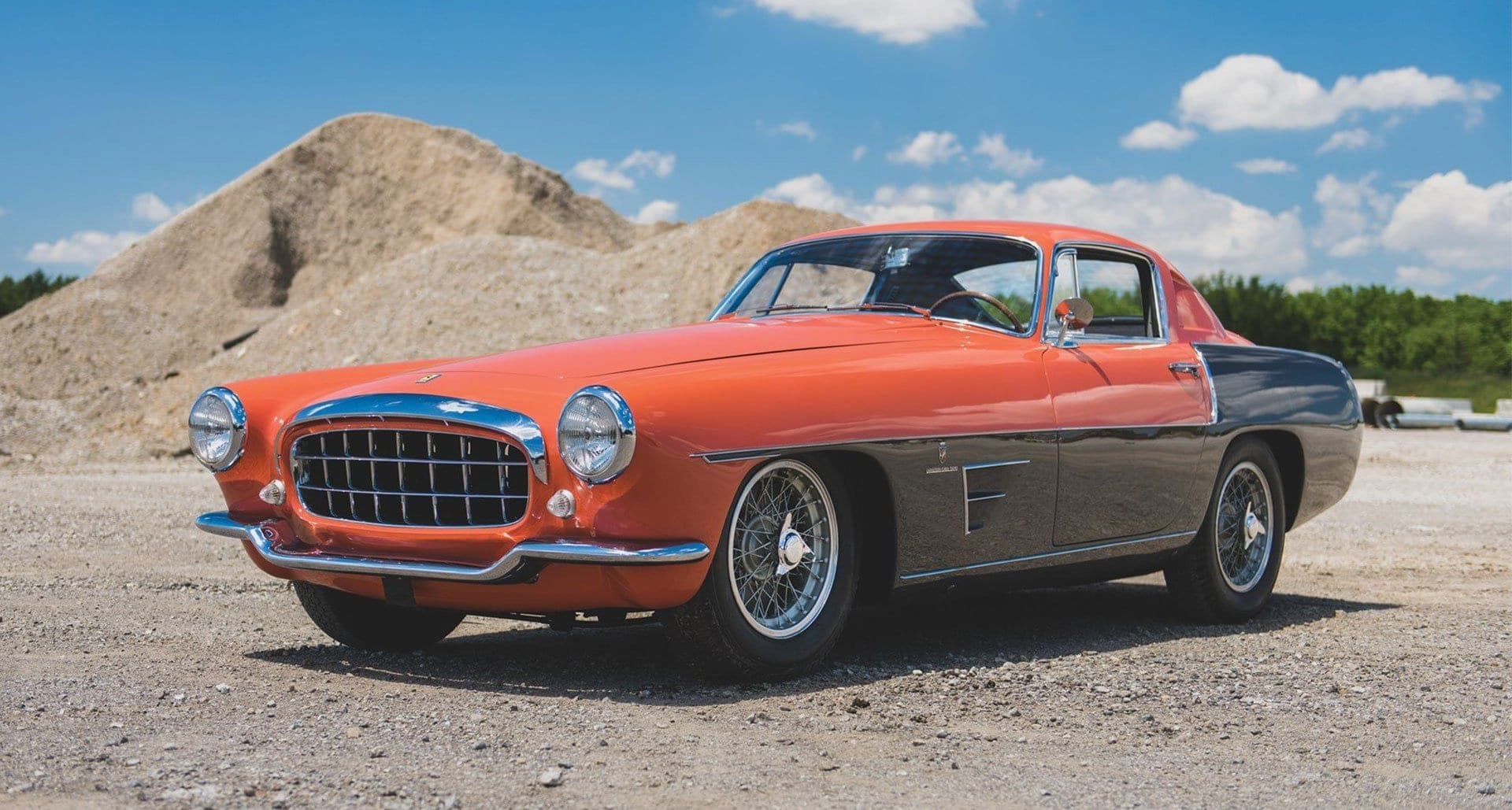
The Ferrari 195 Inter by Ghia, showing the bold proportions and two-tone styling that defined Ghia’s early Ferrari work.
Between 1950 and 1956, only a small number of Ferraris were bodied by Ghia. Yet each of them was distinctive, beautifully crafted and unlike anything else in the Ferrari catalogue.
The early Ghia-bodied Ferraris
One of the first was the Ferrari 195 Inter Ghia, presented in 1951. Its design reflected classic early Gran Turismo proportions, with a large grille, flowing wings and refined two-tone paintwork. When it appeared at the 1951 Turin Motor Show, it drew attention for its elegant and confident presence.

The 195 Inter Ghia from the rear, with its compact proportions and elegant early-1950s coachbuilt character.
A year later came the Ferrari 212 Inter Ghia. More sophisticated in its execution, the 212 Inter featured a prominent chrome grille, carefully sculpted detailing and, in several cases, elegant two-tone colour combinations.
There were also variations on the theme. Some examples were bodied by Ghia in Turin, while others were created by Ghia-Aigle in Switzerland. Each interpreted Ferrari’s grand touring character in a slightly different way.

The Ferrari 212 Inter by Ghia, a more refined evolution of the early Ghia-bodied Ferrari grand tourers.
Around the same period, Ghia also turned its attention to the Ferrari 340 America. Built on the 340 America chassis and powered by Ferrari’s Lampredi V12, the car combined muscular proportions with a luxurious finish. It was a fascinating blend of grand touring refinement and competition-derived aggression.

The Ferrari 340 America by Ghia combined Lampredi V12 performance with grand touring elegance.
The Wilke commissions
Ghia’s collaboration with Ferrari reached its creative peak through two spectacular commissions for American industrialist Robert “Bob” Wilke.
Wilke, owner of the Leader Card Company in Milwaukee, was a close friend of Enzo Ferrari and one of the marque’s important early American clients. His taste for special, individual cars resulted in some of the most striking Ghia-bodied Ferraris ever built.
The first was the Ferrari 375 MM Coupé Speciale. Built on a 1954 chassis and unveiled at the 1955 Turin Motor Show, it stole the spotlight with its sculpted lines, long bonnet and understated elegance.

The 375 MM Coupé Speciale, commissioned by Robert “Bob” Wilke, marked one of the creative high points of the Ferrari-Ghia collaboration.
But the partnership did not end there. For the same client, Ghia created one final Ferrari: the 410 Superamerica Ghia. Wilke himself was involved in the development of its bold design, which stood in clear contrast to Pinin Farina’s more restrained interpretation of the Superamerica.
The Ghia-bodied 410 Superamerica debuted in 1956. With dramatic fins, a powerful stance and an unmistakably American sense of flair, it was one of the most extravagant Ferraris of its era.
Only a single example was built. In many ways, it marked the final flourish of the Ferrari-Ghia partnership.
The end of an era
By the mid-1950s, Ghia’s design philosophy began to diverge from Ferrari’s evolving aesthetic direction.
At the same time, Ferrari strengthened its relationship with Pinin Farina, whose cleaner and more modern design language would become closely associated with Maranello for decades to come.
As a result, Ghia’s collaboration with Ferrari came to an end.
Afterwards, Ghia increasingly turned its attention to the American market, creating designs for Chrysler and later achieving worldwide fame with cars such as the Volkswagen Karmann Ghia and the De Tomaso Pantera.
In 1970, Ghia was acquired by Ford, which continued to use the name for many years as a designation for high-end trim levels.
A rare but cherished legacy
Ghia’s work with Ferrari was brief, but the cars it created remain among the most fascinating coachbuilt Ferraris of the early post-war period.
They represent a rare intersection between two icons of Italian automotive artistry: Ferrari’s racing spirit and Ghia’s bold design flair.
Only a handful were built, but that is precisely what makes them so special. These cars remind us of a time when Ferrari’s visual identity was still being shaped, when Maranello was open to experimentation, and when Italy’s great coachbuilders each left their own signature on the prancing horse.

Image credits: Mario Bernardi Klassische Automobile GmbH, Carrozzieri Italiani, RM Sotheby's & Petersen automotive museum