History
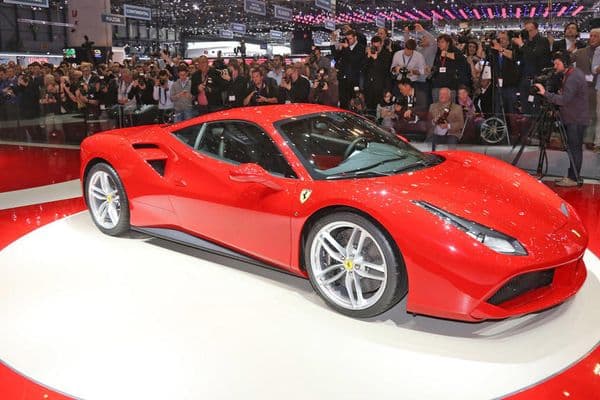
Ferrari introduced the Ferrari 488 GTB at the 2015 Geneva Motor Show as the successor to the 458 Italia. While the overall architecture remained familiar, the shift from a naturally aspirated engine to turbocharging marked a significant change for Ferrari’s mid-engine V8 models. The transition was driven in part by increasingly strict emissions regulations, but Ferrari ensured that performance improved across every measurable metric. The result was widely praised, earning accolades such as Top Gear’s Supercar of the Year in 2015 and Motor Trend’s Best Driver’s Car in 2017. Production of the Ferrari 488 continued until 2019, with an estimated 10,000 to 15,000 units built across all variants.
Technical Details
At the core of the Ferrari 488 lies a 3.9-liter twin-turbocharged V8 engine, producing 670 hp (493 kW) and 760 Nm of torque. Compared to the naturally aspirated engine in the 458, the turbocharged unit delivers significantly more torque at lower engine speeds, while still revving to 8,000 rpm, which is unusually high for a turbocharged engine. Power is delivered through a 7-speed dual-clutch transmission, which can be operated in automatic mode or manually via steering wheel-mounted paddles. Advanced electronic systems ensure that the increased power is effectively managed, allowing the car to remain both fast and accessible.
Performance
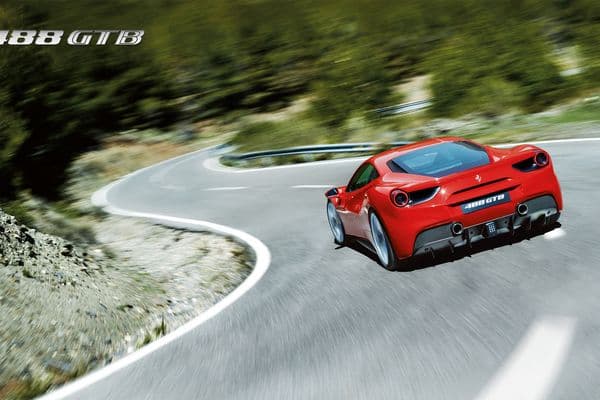
The Ferrari 488 delivers performance figures that remain highly competitive even by modern standards. The Ferrari 488 accelerates from 0 to 100 km/h in 3.0 seconds and reaches 200 km/h in 8.3 seconds, with a top speed of approximately 330 km/h. The turbocharged engine provides immediate torque, resulting in strong acceleration throughout the rev range, while maintaining a level of control that makes the car usable in a wide range of conditions.
Dimensions and Weight
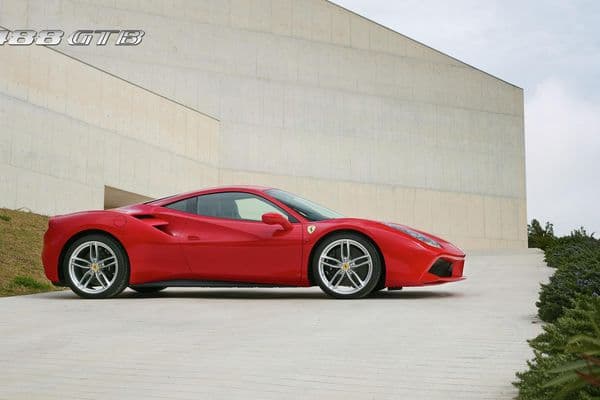
The Ferrari 488 measures 4.560 mm in length, 1.950 mm in width, and 1.210 mm in height, giving it a low and wide stance. Its proportions reflect its mid-engine layout, contributing to both aerodynamic efficiency and dynamic performance.
Variants
Ferrari expanded the Ferrari 488 lineup with several variants, each offering a different interpretation of the platform. The 488 Spider, introduced in 2016, combines the performance of the GTB with open-top driving, featuring a retractable hardtop. The 488 Pista represents the most focused version, with power increased to 720 hp and torque to 770 Nm. Performance improves further, with acceleration from 0 to 100 km/h in approximately 2.85 seconds and a top speed of 340 km/h. The Pista Spider offers the same performance in an open configuration. Ferrari also created more exclusive versions, including the limited 488 Pista Piloti, the J50 developed to celebrate Ferrari’s presence in Japan, the one-off SP38, and the track-only P80/C.
Design
The Ferrari 488 was designed by Ferrari’s in-house design team under Flavio Manzoni. The design is heavily influenced by aerodynamic requirements, with large air intakes and sculpted bodywork that manage airflow efficiently. Despite its functional nature, the car maintains a clean and cohesive appearance.
Interior
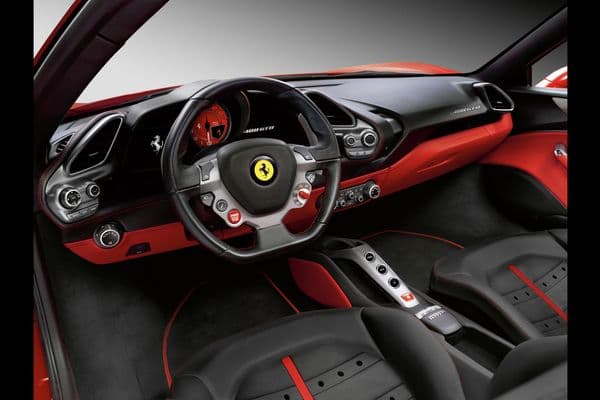
The interior of the Ferrari 488 combines performance-focused design with everyday usability. The layout is centred around the driver, with controls integrated into the steering wheel. The introduction of features such as keyless start reflects the car’s more modern approach. In Pista form, the interior becomes more focused, with increased use of lightweight materials such as carbon fiber, creating a more track-oriented environment.
Prices
The Ferrari 488 occupies a strong position in the modern Ferrari market, offering a balance between performance and usability. Prices for the Ferrari 488 GTB typically start around €200.000 and can rise depending on specification and condition. The more focused 488 Pista and limited variants command significantly higher values, with prices approaching €1 million for the most exclusive versions.
Images courtesy of Ferrari S.p.A.