The Bloodline
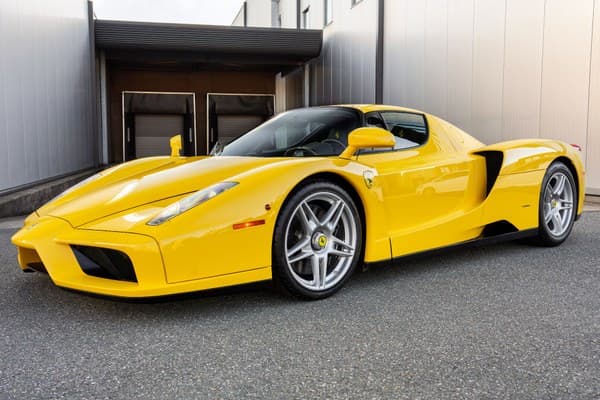
Named after its founder, Enzo Ferrari, the Ferrari Enzo is part of the most prestigious bloodline in the automotive world. This illustrious lineup — which includes the 288 GTO, F40, F50, Enzo, LaFerrari, and the most recent F80 — represents a lineage of hypercars that embodies the magic of the brand from Maranello. The Enzo succeeded the F50 and was unveiled at the 2002 Paris Motor Show. True to Ferrari's exclusivity, only 399 units were planned. A 400th unit followed and was donated to the Pope and the Vatican.
Technical Details
Even today, the Ferrari Enzo remains a technically advanced machine. Ferrari drew heavily from its Formula 1 programme, and it shows. The Enzo is powered by a naturally aspirated 6.0-liter V12 producing 660 hp (485 kW) at 7,800 RPM. It is housed in an ultra-stiff, lightweight monocoque, with aerodynamics efficient enough to earn it the reputation of a Formula 1 car for the road. What makes it particularly special is that the Enzo is one of the last Ferrari hypercars to feature a naturally aspirated V12 before the hybrid era. Power is sent through a six-speed automated manual transmission that shifts at lightning speed.
The suspension is an independent double-wishbone setup with pushrod-actuated dampers, adjustable by the driver. Carbon ceramic brakes complete the package, bringing all that performance to a halt just as effectively as it was unleashed.
Performance
Ferrari F1 legend Michael Schumacher contributed to the development of the Enzo, and the result speaks for itself. The Ferrari Enzo accelerates from 0 to 100 km/h in just 3.6 seconds and reaches a top speed of 350 km/h. The steering is razor-sharp, responding to every input with an immediacy that few road cars can match.
Dimensions and Weight
The Ferrari Enzo measures 4,702 mm in length and 2,035 mm in width. Thanks to its carbon fiber body, the dry weight comes in at just 1,255 kg, remarkable for a car of its performance and presence.
Variants
Based on the already extremely rare Ferrari Enzo, Ferrari introduced the FXX. Only 30 units were produced, one of which went to Michael Schumacher. Launched in 2005 and priced at over 1.5 million euros, it was the most expensive car on the market at the time. The FXX was developed exclusively for the track and lapped the Fiorano circuit an impressive 5 seconds faster than the standard Enzo. In 2007, Ferrari followed up with the FXX EVO, increasing power from 800 hp to 860 hp.
Aerodynamic Design
The design was handled by Pininfarina under head designer Ken Okuyama, shaped like a Formula 1 car from the ground up. Several design elements echo the successful Ferrari F1 cars of the Michael Schumacher era, which is no coincidence. Active aerodynamics run underneath the car, while an automatic rear spoiler deploys at speed. In terms of aerodynamic engineering, the Enzo was genuinely groundbreaking for its time.
Interior
The interior of the Ferrari Enzo is beautifully simple, and deliberately so. Like the rest of the car, it draws clear inspiration from Formula 1. The Enzo was one of the first road cars to feature a proper F1-style steering wheel, complete with shift indicator lights that tell the driver exactly when to change gears. Nothing is there that doesn't need to be.
Images courtesy of Ferrari S.p.A.