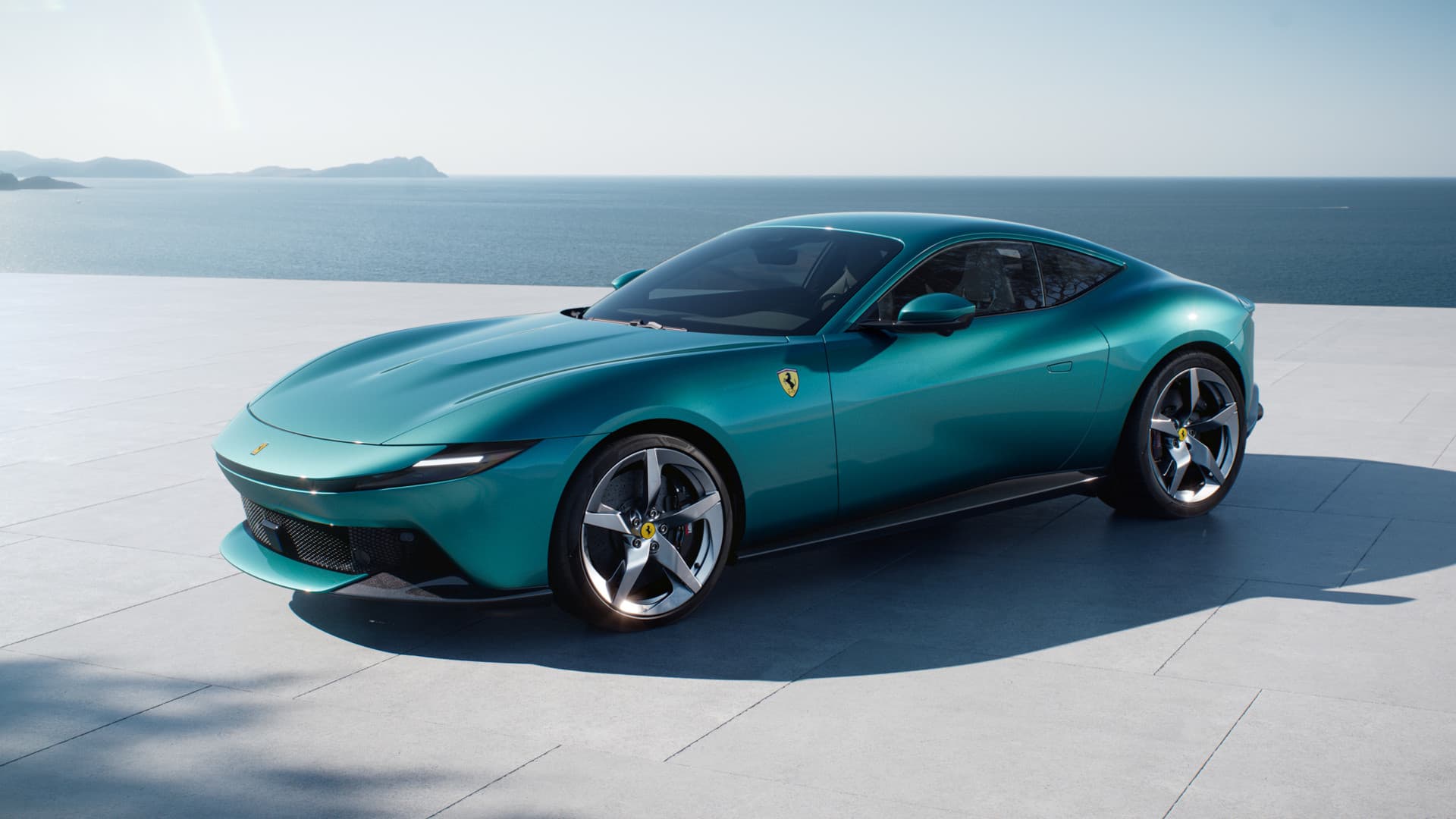

Under the Mediterranean sun, Ferrari unveiled its latest grand tourer in the picturesque coastal town of Amalfi. The launch, attended by invited guests and loyal clients, marked the debut of the Ferrari Amalfi, the successor to the Roma. Named after one of Italy’s most beautiful destinations, the car pays homage to a region beloved by Ferrari owners, making it perhaps the most fitting name yet for Maranello’s elegant GT.
From Roma to Amalfi
The Amalfi replaces the Roma, a crucial model for Ferrari’s growth. The Roma attracted an entirely new clientele — for over 50% of buyers, it was their first Ferrari. Production of the Roma ended in 2024, though the Roma Spider remains on sale until an open-top Amalfi is introduced.
Technically, the Amalfi isn’t a completely new model but an extensive facelift and, as Ferrari often does, one significant enough to warrant a new name.

Design Evolution
At first glance, the Amalfi’s silhouette remains close to the Roma’s, with the same flowing lines and understated proportions. But the front has been completely reworked. The new headlights are linked by a black horizontal strip, a design cue also seen on the 12Cilindri, while the traditional Roma grille makes way for a larger, cleaner air intake integrated into the bumper. Additional cooling comes via subtle vents positioned above the headlights.
At the rear, the changes are more subtle. The twin taillights, a hallmark of the Roma, remain, but with a sharper design. The rear deck between the lights is now flatter, and the number plate has moved lower, no longer integrated into the tailgate, giving the car a wider stance.

A New Interior Philosophy
Inside, the transformation is more pronounced. Ferrari has taken customer feedback to heart, replacing the touch-sensitive controls with physical buttons. The previously vertical central screen is now landscape-oriented, improving usability. The high central console of the Roma has been redesigned into a lower, sculpted unit made from a single piece of aluminium, also available in carbon fibre. The gear selector retains the beautiful gated pattern inspired by Ferrari’s classic manuals, controlling the familiar eight-speed dual-clutch transmission.

Sharpened V8 Performance
Under the bonnet, Ferrari’s familiar 3.9-litre twin-turbo V8 has been refined for more power and response. Output rises by 20 hp, bringing the total to 640 hp and 760 Nm of torque, sent exclusively to the rear wheels. The gains come from revised turbo calibration, new camshafts, a redesigned crankshaft, and weight reductions within the engine.
Despite being Ferrari’s “entry-level” GT, the Amalfi’s performance is anything but modest. It sprints from 0–100 km/h in 3.3 seconds and hits 200 km/h in just 9 seconds, 0.3 quicker than the Roma. Top speed is an impressive 320 km/h.

Arrival and Outlook
The first deliveries of the Ferrari Amalfi are expected in early 2026, with a Spider version likely to follow soon after. By combining classic elegance, refined performance, and a renewed focus on tactile control, Ferrari has built upon the Roma’s success while addressing the desires of its customers.
With the Amalfi, Ferrari redefines the modern grand tourer once again, the perfect car for those who prefer to travel fast, in style and with unmistakable Italian flair.

Image credits: Ferrari S.p.A.