
After years of anticipation, the Ferrari Luce is finally here. Maranello’s first fully electric production car has arrived, and the idea alone was always going to divide opinion. An electric Ferrari is no longer a future scenario. It is now a reality. And after its unveiling in Rome, the noise around it has only grown louder.
A symbolic stage in Rome
Rome was not chosen by accident. In 1947, the Ferrari 125 S took the marque’s first major victory at the Gran Premio di Roma, a defining moment in the earliest chapter of the company’s history. With the Luce, Ferrari is again marking the beginning of a new era. But beyond the symbolism, the comparison only goes so far. The 125 S spoke a language Ferrari would spend decades perfecting. The Luce enters territory the brand has never truly occupied before.

The design everyone is talking about
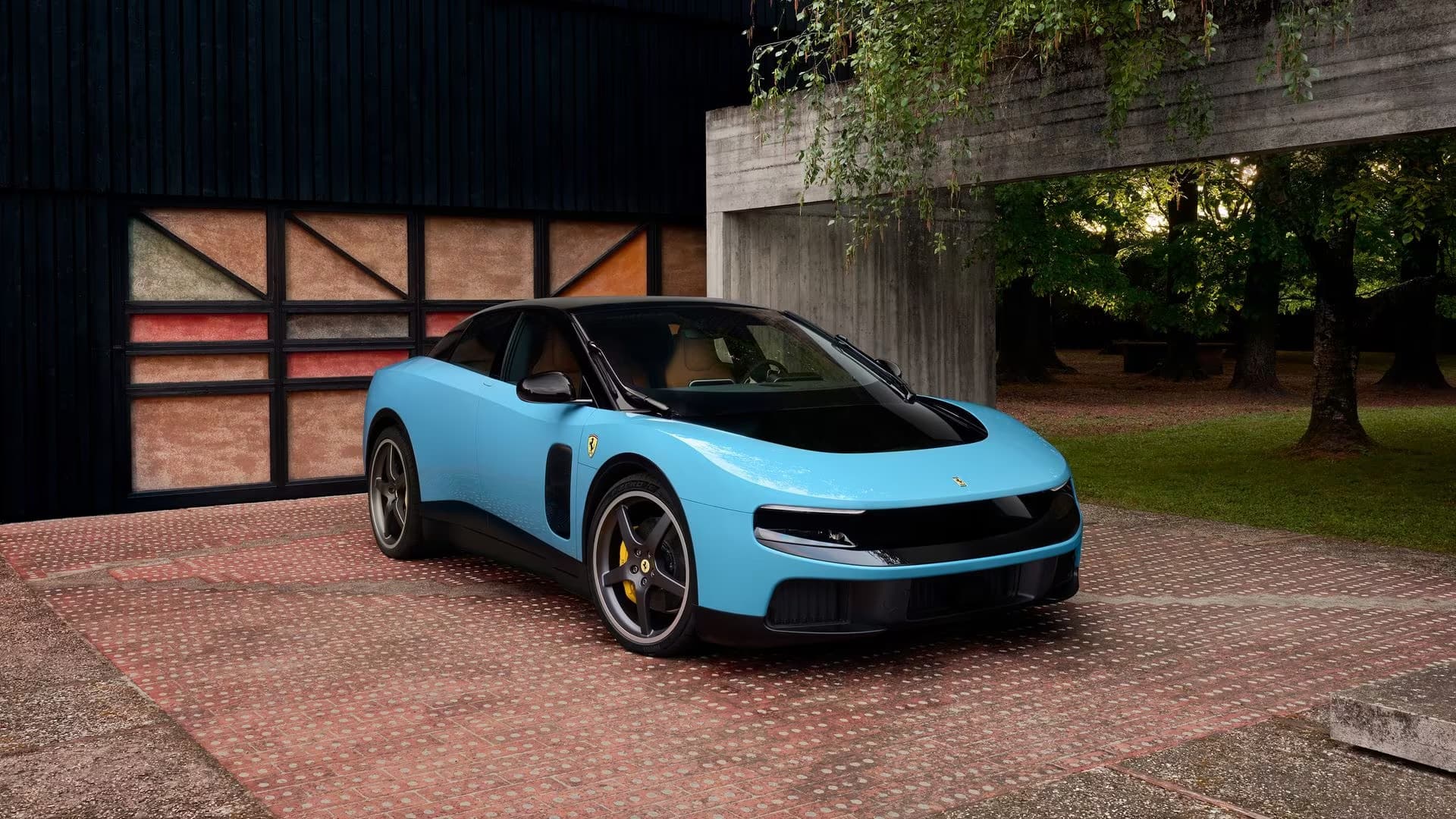
Before the performance figures, battery technology or range, the most controversial part of the Luce has to be addressed: its design. The exterior was shaped with LoveFrom, the design collective led by Sir Jony Ive and Marc Newson, in close collaboration with the Ferrari Design Studio under Flavio Manzoni. Earlier this year, Ferrari already revealed the interior: minimalist, modern and highly considered, with subtle references to great sports cars of the past. Until now, however, the exterior remained hidden. That reveal has quickly become the centre of the conversation.

The Luce is a five-seat, four-door Ferrari with rear-hinged rear doors and a silhouette that refuses easy classification. It is not quite a saloon, not quite a shooting brake, and certainly not a traditional SUV. It is also the first Ferrari production car to offer space for five occupants. Radical is an overused word in car design, but here it applies. Ferrari has not chosen a careful evolution. It has chosen a clean break. Among the most striking details are the enormous staggered wheels: 23 inches at the front and 24 inches at the rear. The optional wheel design, with its distinctive spoke pattern, feels clearly indebted to Ferraris from around the turn of the millennium. To our eyes, it is one of the strongest elements of the car.

At the rear, four round tail-lights return, a familiar Maranello signature reinterpreted for a new context. The body itself has been heavily shaped by aerodynamics, with Ferrari claiming an exceptionally efficient form for one of its road cars.
Early reactions on social media have been far from gentle. Some praise Ferrari for having the courage to create something genuinely new, while others see a design that sits uncomfortably far from the classical beauty on which the marque built its name. That division is already part of the Luce’s identity. This is not a Ferrari asking for quiet approval. It is a car designed to force a conversation.
Four motors, 1,000-plus horsepower

The technical concept of the Luce was already partly known before the full reveal. Four electric motors, one for each wheel, the Ferrari Luce's quad motors generate 1,050 horsepower and 990 Nm of torque. The result is a 0–100 km/h time of 2.5 seconds and a top speed of over 310 km/h.
At 2,260 kg, the Luce is heavy by traditional Ferrari standards, but not unusually so for a large high-performance EV. More important is what the chassis promises to do with that mass. The Luce uses an advanced active suspension system derived from the F80, along with independently steering rear wheels. On paper, that gives Ferrari the tools to make the car feel far more agile than its size and weight suggest.
The Luce uses an advanced active suspension system derived from the F80, along with independently steering rear wheels. On paper, that gives Ferrari the tools to make the car feel far more agile than its size and weight suggest.
Then there is the question of sound. The familiar cry of a high-revving V8 or V12 is, of course, absent. Instead, Ferrari has developed a new sensory approach around the electric powertrain, using amplified vibrations and sound characteristics from the motors rather than simply imitating an engine. Whether that feels authentic, theatrical or somewhere in between will only become clear once the car is experienced on the road.
Range and reality

With any electric car, range is unavoidable. Ferrari quotes a range of around 530 km. Given the performance, battery size and positioning of the Luce, that figure is respectable rather than revolutionary. Several electric luxury saloons now go further. But for Ferrari’s target customer, that may not be the deciding factor. The Luce is not trying to win a range contest. It is trying to prove that Ferrari can translate its sense of occasion into an electric format.
A controversial milestone
The Ferrari Luce will be priced well above half a million euros, placing it firmly at the top end of the electric performance market. Whether its design will age into brilliance or remain divisive is impossible to say after a single reveal. The first road tests will also determine whether the technology delivers on Ferrari’s promise.
But as a milestone, its place is already secured. The Luce is not controversial simply because it is electric. It is controversial because it asks whether a Ferrari can still feel like a Ferrari when almost every traditional Ferrari ingredient has been removed: the engine, the sound, the proportions, even the familiar idea of what a Ferrari should look like.
That question will not be answered by a spec sheet. It will be answered on the road. But one thing is already clear: controversial or not, the Luce is the moment Ferrari stepped fully into the electric age.

Image credits: Ferrari S.p.A.